Restoring trust in crypto - How industry veterans are taking the lead: Recap on webinar with BitGo
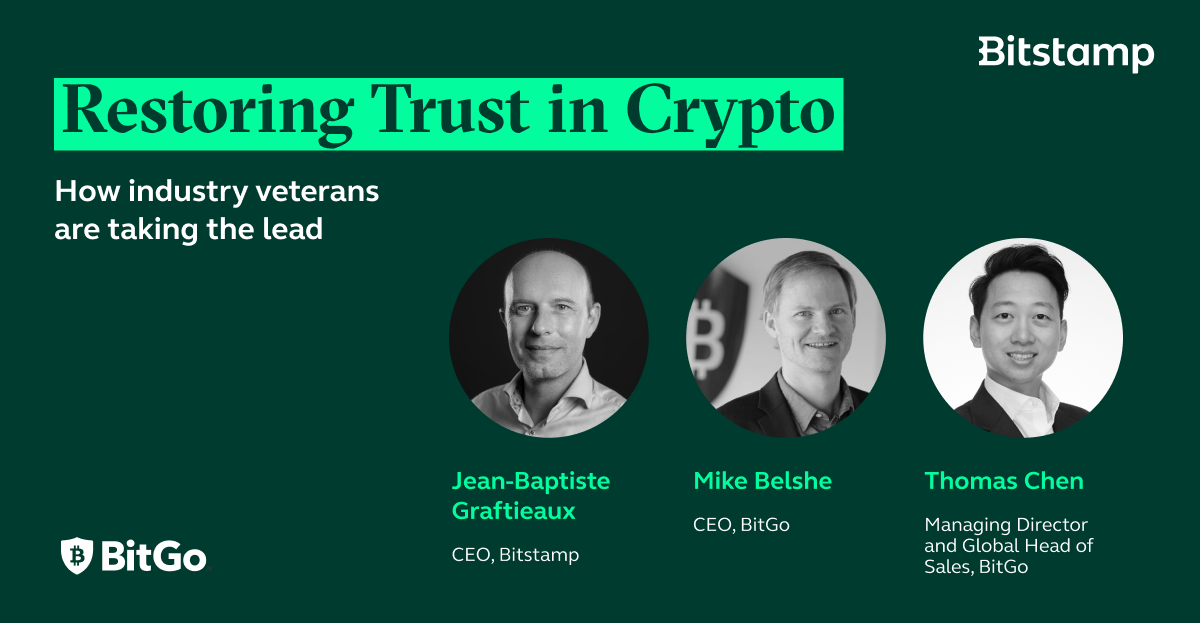
In case you’ve missed the webinar on Restoring trust in Crypto - How industry veterans are taking the lead - on December 7, 2022, we’ve prepared a recap of the event’s proceedings. Two of the longest-running crypto companies, Bitstamp and Bitgo, shared their thoughts on how to build back stronger foundations of trust, security and regulation after the recent collapse of FTX. Custody, compliance and market structure were some of the key points of the discussion:
- Not all custody is created equal
- Market structure needs to be built and continue to evolve
- Smart regulation will allow massive adoption of crypto
On our relationship with BitGo
Mike Belshe, co-founder and CEO at BitGo, explained that the two companies have an 8-year-long relationship which started in early 2014 when Bitstamp was looking to increase security and expand custody on their platform (bringing in multi-signature wallets – an industry first). Mike noted: “It has been a privilege to watch Bitstamp grow and to be a key part of the entire ecosystem for such a long period of time.”
JB Graftieaux, Bitstamp’s CEO, agreed with Mike and pointed out that with nearly 80 assets on offer to clients worldwide, the key decision-making process at Bitstamp in choosing and creating partnerships is to find new ways to increase security for the customers and their funds.
On the market structure of crypto
Thomas Chen, Managing Director and Global Head of Sales at BitGo, who was moderating the panel, addressed the fact that in the scope of the FTX fallout, one thing is clear: the market structure still needs to evolve.
The discussion continued with each of the CEO’s views on what needs to be done to improve the market structure and the efforts of each company in this regard.
JB pointed out that Bitstamp’s risk capital over the last 11 years has been quite low, and the company has been very selective with partners when it comes to custody. That is why we have been working very closely with BitGo. In addition, Bitstamp has been working with best-in-class technology providers, such as Nasdaq, to offer maximum safety to the users. Today, Bitstamp holds over 50 licenses and registrations globally, complying with regulations that enable operations in all the countries Bitstamp is present it. Bitstamp’s DNA has been driven by effective risk management to offer unmatched security to both institutional and retails users. Due to its low-risk capital, Bitstamp has not been exposed to FTX . In fact, the firm has seen an influx of clients to the platform in the last weeks, as they prioritize the safety of their assets.
Mike continued with FTX, saying that its failure was a surprise for most. The recent developments show a lack regulatory monitoring which has allowed some companies to operate in fraudulent ways. He stressed that it is important to know that it was people who failed with their actions and not digital assets, and that highlights a need for an improved market structure. He further expanded with a question for the market: Where should we allow for risk to exist in the system and where should we not? “When it comes to market structure, we need to make sure we don’t have untold risks. The risk needs to be clearly identified. And we need transparency, proof that the entities have the assets they are claiming to have and to disclose any liabilities they may hold. In traditional markets, heavy regulatory burden makes that happen, in crypto markets we need to make sure these companies and entities are not taking risk without some oversight.” He further expanded his argument that proof of reserves is only a part of the story because you also need to prove a non-existence of liabilities.
Role of a custodian and segregation of duty
Mike started out his argument by stating: “Not all custody is created equal, anyone can accept digital assets but there is a difference in how the assets are held and protected”. He explained that Bitgo offers a custodial service as a regulated qualified custodian. “A regulator is aware of our activities, ensures we meet certain standards and comes and looks at out books and records to make sure we are compliant with BSA and other rules.”
JB explained how the issue is dealt with at Bitstamp, stating that Bitstamp has full transparency with each regulator, working with them and reviewing processes and data daily. Additionally, Bitstamp is audited and reviewed by one of the big four accounting firms on a yearly basis.“The money of our clients is segregated and safeguarded separately from our company’s money, meaning their funds always remain theirs. As a regulated exchange, we intend to push the market forward.”
On efficient markets and transparency: CeFi vs DeFi
JB pointed out that the crypto market is still young, and it has taken time for regulators to define and develop some level of regulation to try manage and balance the ecosystem. At the moment, there is a regulatory puzzle in Europe – each country has their own approach to crypto. MiCA (Markets in Crypto-Assets) will bring a few very important components, and companies will have to enable risk management capabilities which will create more trust among users. As a result, more institutions will enter the crypto space. On CeFi vs DeFi, JB believes that we can benefit and expand from DeFi on the crypto market. “I don’t think it’s one or the other, they’re two different business models with their own use cases that we can offer to our consumers.”
Mike, on the other hand, stated that in the short term “some of the CeFi players like traditional banks and will see a win.” However, long term: “DeFi is the big winner, but the market structure is being built slowly and isn’t figured out yet. In order to eliminate risk from market structure, we need to mandate it - separate our roles or DeFi starts to step in and fill those voids. It can take out the counterparty risk and make it more public even without any regulatory oversight.”
To dive deeper into the discussions, you’re welcome to [watch the full webinar].